Earth’s mantle locally heats up our planet’s core
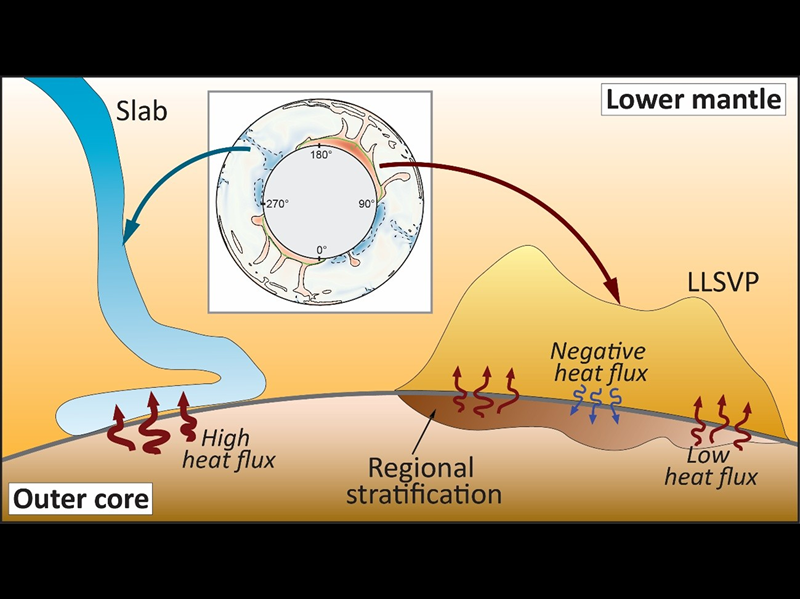
The boundary between the Earth’s mantle and core (CMB), at about 2900 km depth, is a key region of our planet. It controls the heat that can be extracted from the core and transported up to the surface by convection movements in the mantle. As such, it also controls the cooling and dynamics of the core and its associated geodynamo process, which generates the Earth’s magnetic field. Using numerical simulations of mantle convection, IES researchers showed that beneath regions known as large shear-wave velocity provinces (LLSVPs), which are thought to be hotter than their surroundings and enriched in iron, the amount of heat that can be extracted from the core to the mantle is lower than the amount of heat provided by the core, and that, locally, heat may even flow from the mantle to the core. By contrast, heat flux beneath slabs arriving at the CMB is high, leading to strong lateral heat flux heterogeneity. This may lead to regional stratification occurs at the top of the core and explain the onset and termination of geomagnetic superchrons. Research team includes Dr. F. Deschamps, J.M. Guerrero and W.-P. Hsieh from IES, and Dr. H. Amit from University of Nantes. Results were published on June 17th, 2026 in Nature Geoscience (https://www.nature.com/articles/s41561-026-02018-w).
Deschamps, F., Guerrero, J.M., Amit, H. et al. Negative core–mantle boundary heat flux beneath low-shear-wave-velocity provinces. Nat. Geosci. (2026).
Article link: https://doi.org/10.1038/s41561-026-02018-w
Post by Academia Sinica: https://www.sinica.edu.tw/en/news_content/36/3861
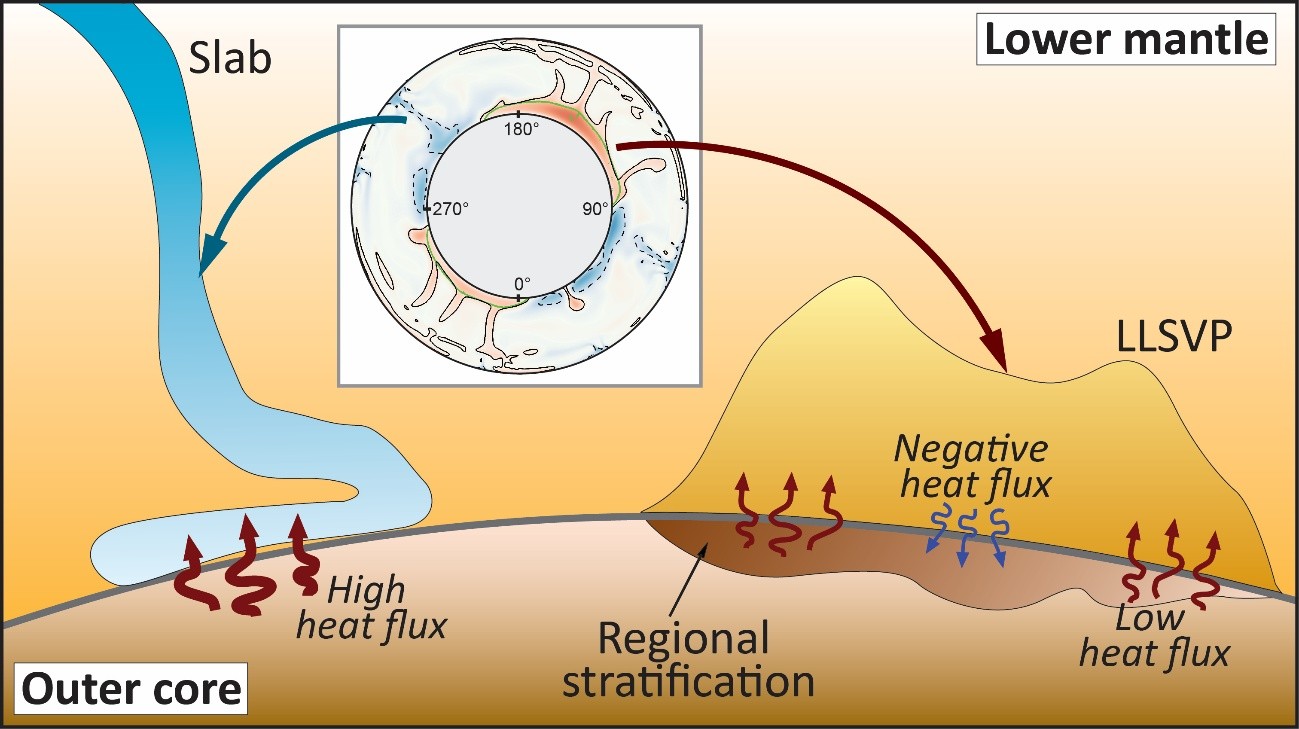 Heat flux at the core-mantle boundary. According to simulations of mantle convection, heat flux beneath piles of hot, dense material (LLSVP) is low and may even be negative. © F. Deschamps.