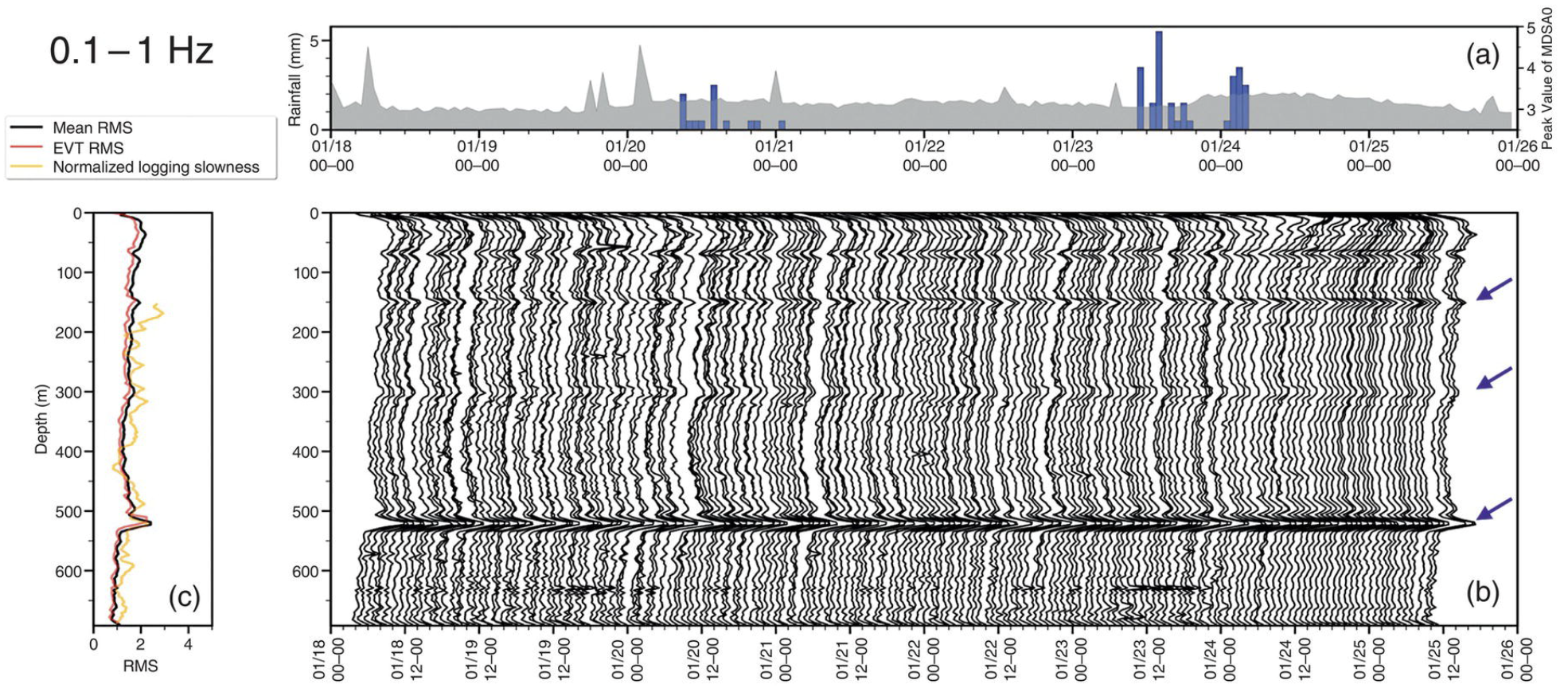
The occurrence of seismic or aseismic slips on a fault is mainly controlled by fault zone structures and properties. However, high-resolution in situ observations are challenging for active faults with uncertain locations or weathered outcrops. The Milun Fault, which repeatedly ruptured during the 1951 and 2018 Hualien earthquakes in Taiwan, offers a unique opportunity to investigate active fault zones using distributed acoustic sensing (DAS). DAS translates the phase shifts of scattering echoes in optical fibers into dynamic strain measurements, enabling continuous, high-resolution monitoring across fault zones. The Milun Fault Drilling and All-inclusive Sensing (MiDAS) project, initiated in late 2021, drilled two holes on either side of the fault and reached the fault zone at a depth of approximately 500 m in hanging wall. The high-density sampling of downhole fibers enables us to identify the 20-meter-thick Milun Fault zone and other hidden faults at various depths. An amplitude-based method that utilizes strain-rate data properties is proposed to map subsurface velocity structures over time, with the derived velocity profiles consistent with logging data. This method shows great potential for detailed temporal structural monitoring in broad applications such as energy exploitation, groundwater management, and geohazard monitoring.
Full Article:
Huang, H.-H., Ma, K.-F., Wu, E.-S., Cheng, Y.-Z., Lin, C.-J., Ku, C.-S., Su, P.-L. and MiDAS Working Group (2024). Spatiotemporal Monitoring of a Frequent-Slip Fault Zone Using Downhole Distributed Acoustic Sensing at the MiDAS Project. In Distributed Acoustic Sensing in Borehole Geophysics (eds Y. Li, R. Mellors and G. Zhan). https://doi.org/10.1002/9781394179275.ch26